Sustainability
Plastic cup vs paper cup vs kulhad vs steel: which is greenest?
There’s no single greenest cup. It comes down to one number, how many times a cup gets used, and to how it’s washed. Here’s what the life-cycle studies say.
MUSTHAV team · · 5 min read
Ask which cup is greenest and you’ll hear strong opinions. The research gives a clearer answer: it depends mostly on how many times a cup is used, and how it’s washed.
The short answer
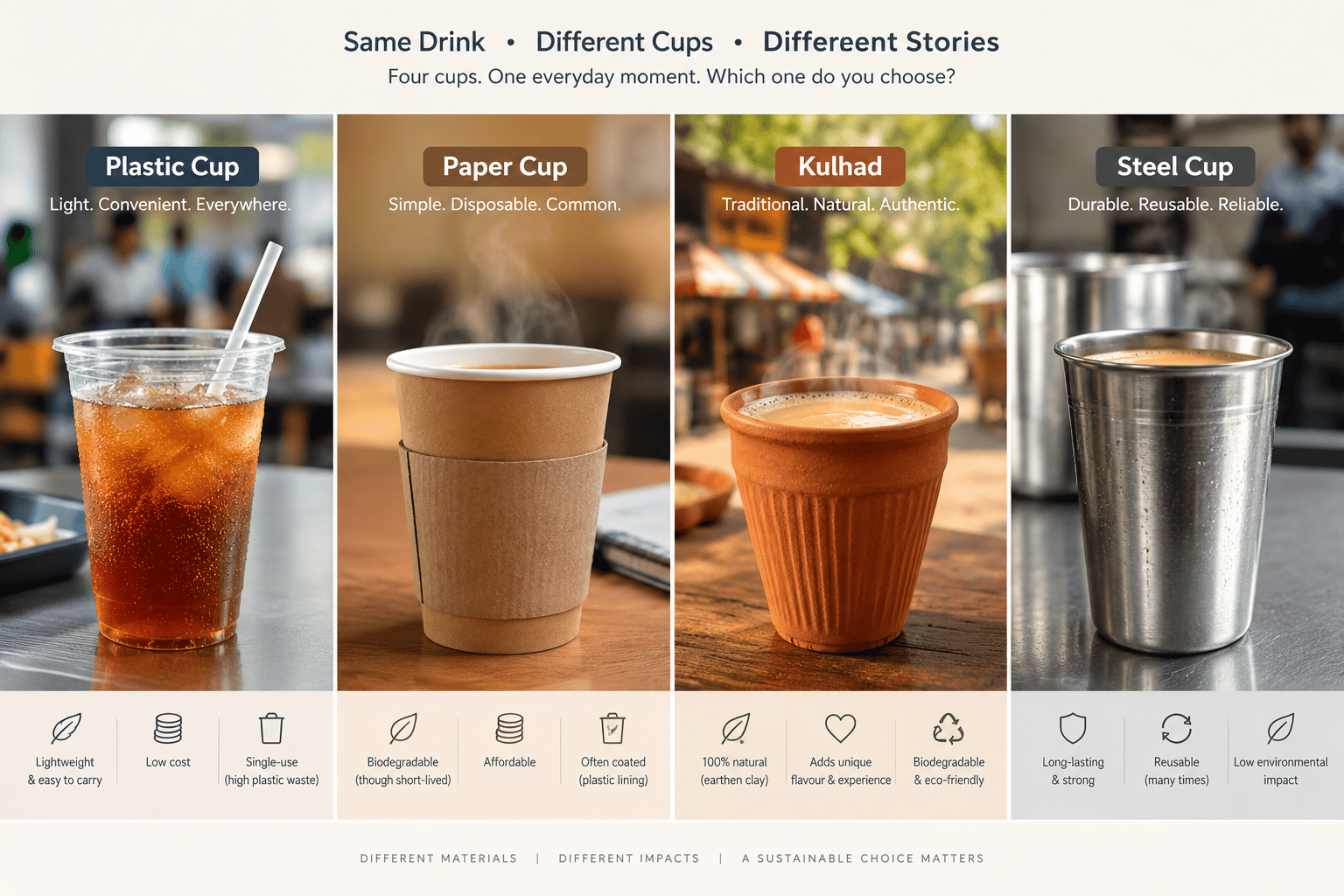
- Steel glass: the greenest choice once it’s reused many times and washed efficiently.
- Kulhad: natural and local, but still used only once.
- Paper cup: lined with plastic, sheds microplastics into hot drinks and is hard to recycle.
- Plastic cup: banned since 2022, and the worst at the end of its life.
Reuse wins, if the cup is really reused
A 2025 life-cycle study for the Australian and New Zealand governments found that a cafe-washed reusable cup beat single-use hot cups after about 15 to 20 uses, and single-use cold cups after about 40.[4]
An earlier study for Québec found a ceramic mug had a smaller environmental impact than a paper cup with a lid once it was used 200 to 300 times. It also became cheaper for the restaurant after about 45 uses.[5]
The numbers differ because the studies used different cups, washing methods and electricity. But they point the same way: a reusable cup that’s used many times beats any disposable one.
Washing is where it can go wrong
The same Australia–New Zealand study found the water impact of reusable cups depends heavily on washing. Commercial dishwashers used less water than home dishwashers, and washing by hand used the most.[4]
So a steel glass rinsed under a running tap, or dipped in a bucket, isn’t automatically the green choice. Reuse needs washing that’s quick, hygienic and sparing with water.
Plastic cups
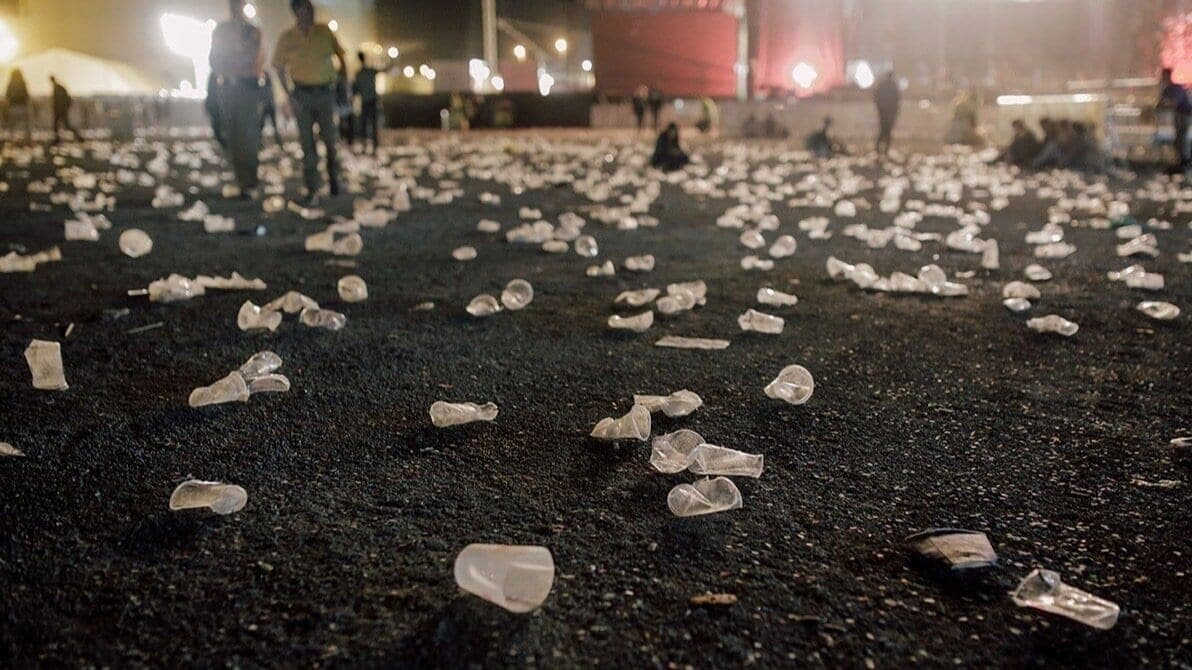
Plastic cups and glasses have been banned in India since 1 July 2022. Even so, a 2025 field survey found banned single-use plastics still in use at 84% of the sites it checked in four cities.[1][2]
They’re light, food-soiled and worth almost nothing to waste pickers, so most are dumped or burnt instead of recycled.
Paper cups
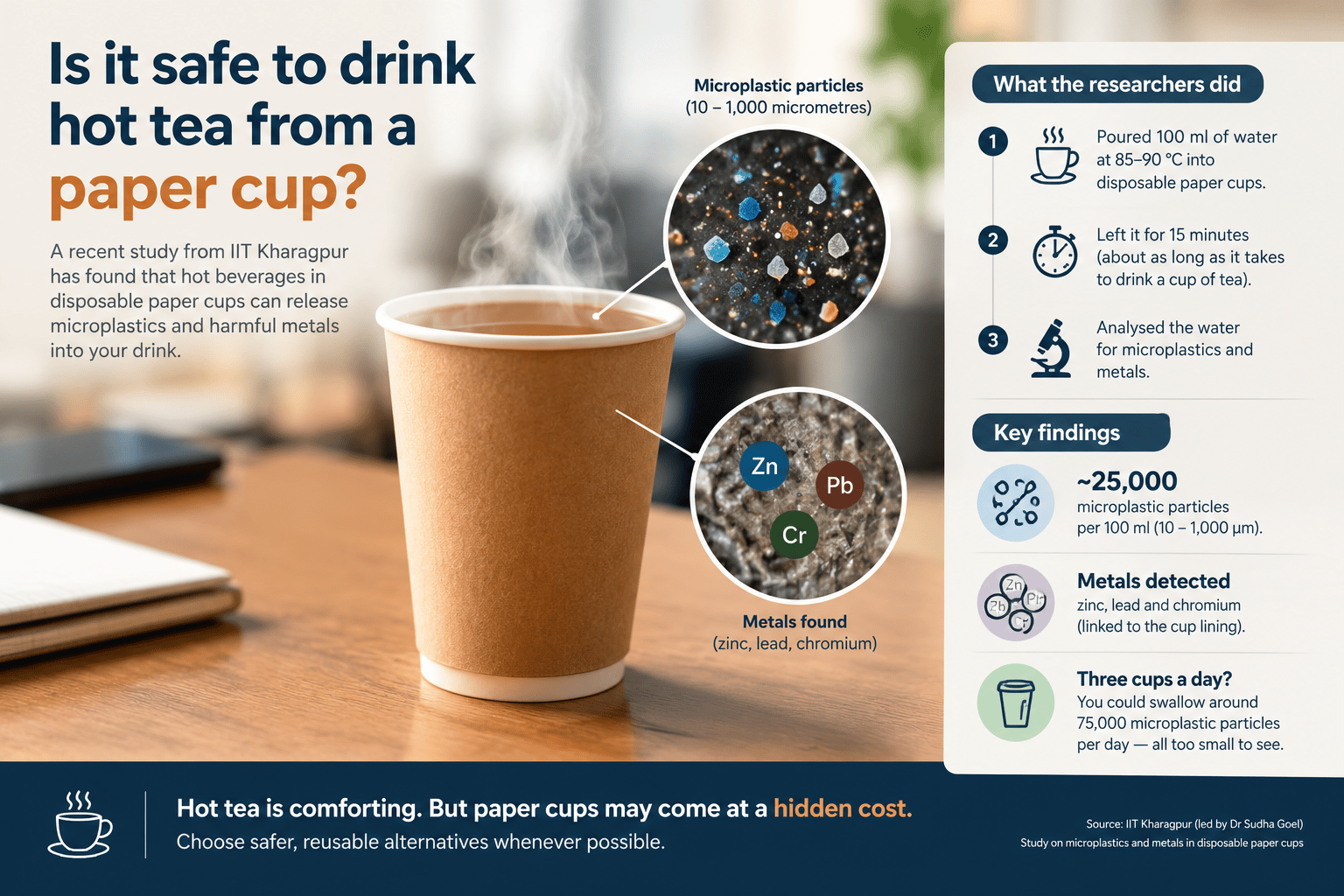
A paper cup looks like the eco option, but it’s lined with plastic to hold liquid. In an IIT Kharagpur study, 100 ml of hot water left in one for 15 minutes held around 25,000 microplastic particles.[3]
The lining also makes paper cups hard to recycle, because the plastic film has to be separated from the paper first.
Kulhads
Clay kulhads have been used in India for generations. Cost, convenience and ease of transport pushed them aside in favour of plastic and paper cups.[6]
A kulhad is made from natural clay and breaks back down into soil. But it’s still used once, and each one takes clay and fuel to fire. Kulhads make most sense near potter clusters, where they also support local jobs.
Steel glasses
The steel glass is India’s traditional answer, and it can last for years. Its footprint comes from making it once and then from every wash. Get the washing right and it comes out ahead.
The bottom line
- Where people drink on site, use a reusable glass and wash it efficiently.
- Where reuse isn’t possible, a kulhad is better than plastic or plastic-lined paper.
- Treat a paper cup as a plastic cup, not as an eco upgrade.
That’s the idea behind GILAS: a steel glass for every drink, cleaned on the spot with about 100 ml of water per cycle by design, so reuse doesn’t cost more water than it saves.
Sources
- [1]Government of India, Press Information Bureau (2022), ban on identified single-use plastic items from 1 July 2022 under the Plastic Waste Management (Amendment) Rules, 2021. View source (opens in a new tab)
- [2]Toxics Link (2026), Revisiting the Single-Use Plastic Ban: field survey of 560 sites in Delhi, Mumbai, Guwahati and Bhubaneswar, April–August 2025. View source (opens in a new tab)
- [3]Ranjan, V. P., Joseph, A. and Goel, S. (2021), Microplastics and other harmful substances released from disposable paper cups into hot water. Journal of Hazardous Materials, 404, 124118 (IIT Kharagpur). View source (opens in a new tab)
- [4]Lifecycles for Australian state and territory governments and the New Zealand Ministry for the Environment (2025), Life cycle assessment of single-use plastic items and their alternatives in Australia and New Zealand. View source (opens in a new tab)
- [5]CIRAIG for RECYC-QUÉBEC (2014), Life cycle assessment (LCA) of reusable and single-use coffee cups: summary. View source (opens in a new tab)
- [6]Sangwan, K. S., Sodhi, M. S., Spengler, T. S. and Thies, C. (2021), Exploring the three dimensions of sustainability related to clay cups. Procedia CIRP, 98, 139–144. View source (opens in a new tab)
See GILAS working in your setting.
Book a 15-minute demo for your school, hospital, event or office.
Request Demo