Sustainability
India banned plastic cups in 2022. Why are they still everywhere?
Three years after the single-use plastic ban, a field survey found banned items at 84% of sites in four cities. A ban removes an option; it doesn’t supply an alternative.
MUSTHAV team · · 4 min read
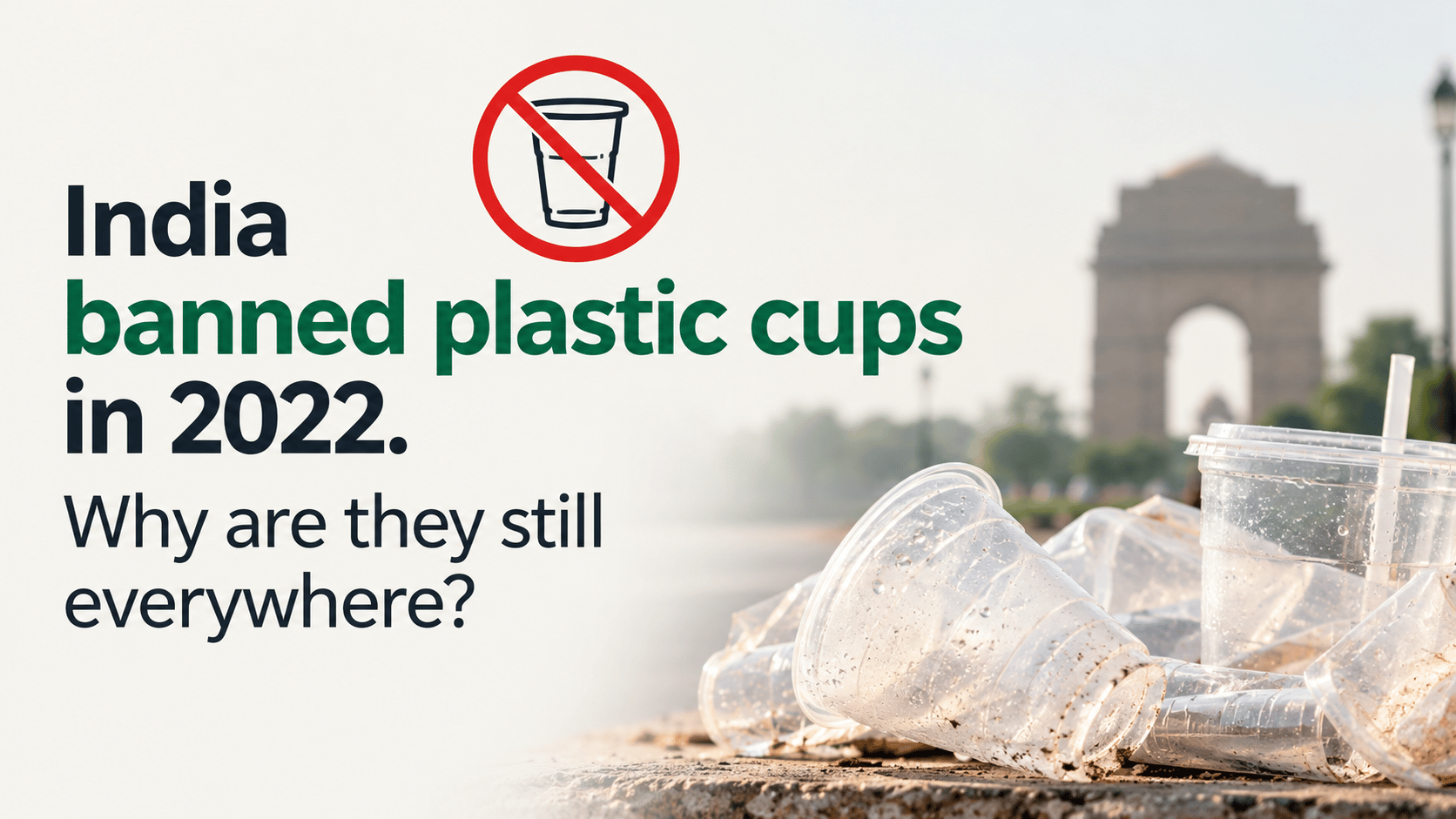
On 1 July 2022, India banned the manufacture, sale and use of a list of single-use plastic items. Plastic cups and glasses were on that list, alongside cutlery, straws and thermocol decorations.[1]
Three years on, the cups haven’t gone anywhere. Between April and August 2025, Toxics Link surveyed 560 sites across Delhi, Mumbai, Guwahati and Bhubaneswar, and found banned single-use plastics still sold or used at 84% of them, from 76% in Guwahati to 89% in Bhubaneswar.[2]
Why the ban hasn’t stuck
The survey found the worst compliance in informal markets, street stalls and small eateries, while malls and organised retail did noticeably better. That pattern points to a simple problem: a ban takes an option away, but it doesn’t hand anyone a replacement.[2]
At a busy water point, a tea stall or a wedding counter, the practical choices are a plastic tumbler or a shared glass rinsed in a bucket. When the alternative is less hygienic and more work, plastic keeps winning.
What a real alternative needs
- It has to be at least as hygienic as a fresh disposable cup.
- It has to work where people actually drink: no plumbing, no back room, no extra staff.
- It has to keep up with a queue, not just a dinner party.
That’s the gap GILAS is designed to fill: a contact-free water dispenser that serves every drink in a steel glass, then cleans and disinfects it on the spot in about a minute, so the hygienic option is also the easy one.
Sources
- [1]Government of India, Press Information Bureau (2022), ban on identified single-use plastic items from 1 July 2022 under the Plastic Waste Management (Amendment) Rules, 2021. View source (opens in a new tab)
- [2]Toxics Link (2026), Revisiting the Single-Use Plastic Ban: field survey of 560 sites in Delhi, Mumbai, Guwahati and Bhubaneswar, April–August 2025. View source (opens in a new tab)
See GILAS working in your setting.
Book a 15-minute demo for your school, hospital, event or office.
Request Demo