GILAS for hospitals & clinics
Drinking water that matches your infection-control standards.
OPD waiting areas, wards and canteens serve water all day, in plastic cups or shared tumblers. GILAS replaces both with a contact-free dispenser that serves water in steel glasses, cleaned and disinfected after every use.
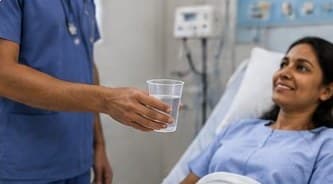
Where it fits
- OPD waiting areas
- General wards
- Canteens and cafeterias
- Staff rooms
The problem today
OPD waiting areas, wards and canteens run on plastic cups or shared tumblers, in the one place where infection control matters most.
- 01
Shared cups where patients gather
Waiting areas full of unwell people share water points, the very place cross-contamination should be lowest.
- 02
Plastic piling up
Disposable cups add a steady stream of general waste in wards, waiting rooms and canteens.
- 03
Visible to assessors
Cleanliness, hygiene and waste are scored in external assessments. Overflowing cup bins are hard to miss.
With GILAS
Contact-free drinking water and a closed clean-and-disinfect cycle for glasses in non-clinical areas, with no plastic waste.
A closed, visible hygiene cycle
Every glass is spray-washed, ultrasonically cleaned and UV-C disinfected before reuse, designed to cut pathogens by 99.9%.
Less general waste
One steel glass replaces thousands of plastic cups in non-clinical areas.
No plumbing works
The portable variant needs no new water lines or drains in a ward or waiting area, just a wall socket.
Cycle time and pathogen-reduction figures are design targets pending independent validation. See full specifications
How to get GILAS
Built for Kayakalp and NABH goals
- Supports the hygiene, infection-control and waste-management areas scored by the Kayakalp Award Scheme.
- Fits the infection-control and housekeeping expectations of NABH accreditation.
- Available to buy or lease; public facilities can procure through GeM.
For drinking glasses in non-clinical areas only. GILAS is not a medical device and does not replace clinical sterilization or biomedical-waste procedures.
Impact calculator
How many plastic tumblers could your hospital replace?
Your estimate
Plastic
- Plastic tumblers avoided per year
- 3,65,000
- Plastic waste avoided per year
- 1.1 t
- CO₂e avoided per year
- 998 kg
Hygiene
- Drinks served in a cleaned, disinfected glass per year
- 3,65,000
Money
- Estimated running-cost savings per year
- ₹6,20,500
CO₂e breakdown: 2.8 t from making tumblers + 10 kg from disposal (dumped or landfilled) − 1.8 t for GILAS washing = 998 kg avoided.
A fresh plastic tumbler is hygienic but single-use; GILAS keeps every drink in a cleaned, disinfected glass without the waste. GILAS would use about 36,500 litres of water a year to clean these glasses. This is an estimate, not a guarantee of savings or health outcomes. Plastic CO₂e uses published factors; the GILAS wash figures are placeholders until our lifecycle assessment and hygiene validation are complete.
Share this estimate
How we calculate this
Tumblers per year = guests × drinks per guest × events per year (events), or people × drinks per person per day × days open per year: 220 for schools, 365 for hospitals, and the working days you enter for offices (default 250). You choose what share of those drinks are served today in new plastic tumblers; the rest are assumed to come in shared glasses washed by hand.
Plastic waste = tumblers × the tumbler weight you pick (default 3 g).
Hygiene: every drink is served in a glass that GILAS has spray-washed, ultrasonically cleaned and UV-C disinfected, a cycle designed to cut pathogens by 99.9% (independent validation under way). Shared-glass reuses replaced = drinks served in shared glasses today. Staff hours freed = those drinks × hand-washing seconds per glass ÷ 3,600. We do not estimate illnesses avoided, because that depends on many factors we can’t measure.
CO₂e avoided = plastic weight × (making factor + disposal factor) − tumblers × 0.005 kg per GILAS wash. Making factors, including forming into a product, are 2.569 kg CO₂e per kg for PP, 4.367 kg CO₂e per kg for PS, 3.855 kg CO₂e per kg for PET; landfill is 0.0089 and recycling 0.0064 kg CO₂e per kg, from the UK Government GHG Conversion Factors for Company Reporting 2024 (DESNZ). Burning releases the carbon in the plastic as CO₂: 3.14 kg per kg for PP, 3.38 kg per kg for PS, 2.29 kg per kg for PET (from each plastic’s carbon content; open burning also releases other pollutants not counted here). We give no credit for recycling, and treat GILAS washing and hand-washing of shared glasses as equal, so shared-glass drinks add no CO₂e either way. The GILAS wash figure is a placeholder until we measure it.
Savings = tumblers × (your tumbler cost, default ₹2, − ₹0.3 per GILAS wash) + staff hours freed × your staff cost per hour − shared-glass drinks × ₹0.3 per GILAS wash. This excludes the cost of buying, leasing or renting GILAS and of the GILAS glasses.
Payback = the GILAS price you enter ÷ monthly savings. It is shown only when you enter a price, and ignores maintenance, consumables and financing.
Water = tumblers × 100 ml per cycle (claimed, pending validation).
Results are rounded to whole numbers. The emission and cost factors are placeholder assumptions that will be replaced by figures from an independent lifecycle assessment. Real-world results depend on your cups, electricity source and how often glasses are reused.
What people say
“Plastic cups were piling up in our OPD waiting area. GILAS gave us a clean, visible drinking-water point our assessors noticed.”
Hospital Administrator
District hospital
Sample testimonial
Can GILAS be used in clinical areas?
No. GILAS is for drinking glasses in non-clinical areas such as waiting rooms, wards, canteens and staff rooms. It is not a medical device and does not sterilize instruments.
Is the glass sterilized?
GILAS cleans and disinfects. We will only use the word “sterilized” if third-party validation supports it.
How do public hospitals buy GILAS?
Through direct purchase or lease, and through GeM for public facilities. We can time pilots ahead of your assessment cycle.
See GILAS in action.
Book a 15-minute demo and we’ll show how GILAS would work in your hospital.