GILAS for schools
A clean glass for every child, every time.
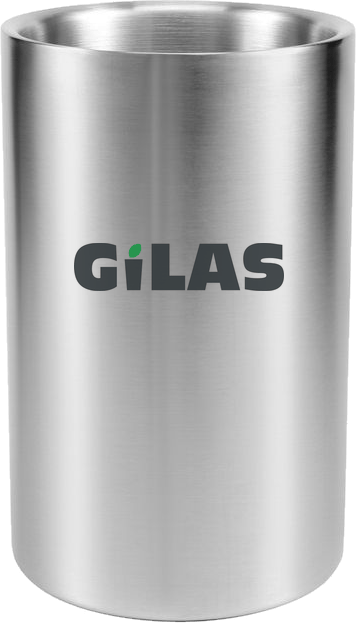
At school water points and mid-day meals, children either share one tumbler or get a plastic cup they throw away. GILAS gives each child drinking water at the press of a button, in a steel glass that is cleaned and disinfected between every use.
Where it fits
- Drinking-water points
- Mid-day meal service
- Hostels and boarding houses
- Staff rooms and offices
The problem today
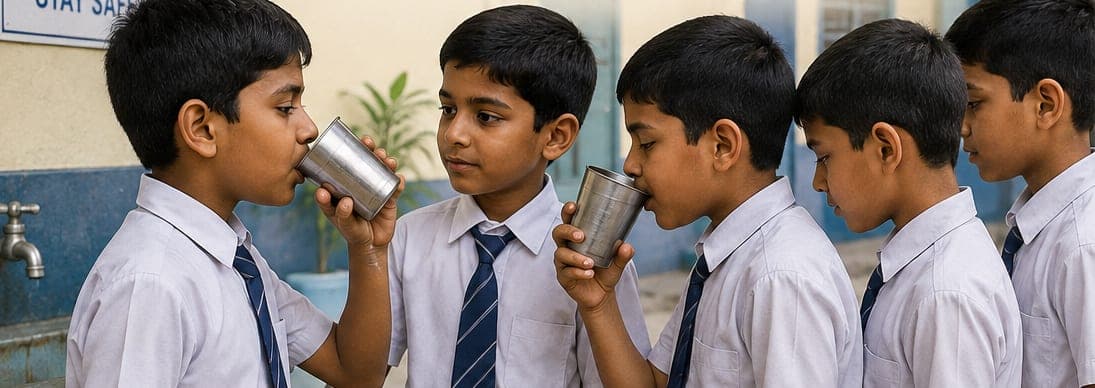
Children share tumblers at water points and mid-day meals, or are handed plastic cups that end up in the playground.
- 01
One tumbler, a whole class
A single steel tumbler chained to the water cooler passes from mouth to mouth all day, usually without a wash.
- 02
Plastic in the playground
Where schools switch to disposable cups, they end up in drains, playgrounds and burning heaps behind the building.
- 03
No time, no staff, no sink
Teachers and cooks can’t wash hundreds of glasses between periods, and many water points have no running water at all.
With GILAS
Every child gets water in a glass that has just been cleaned and UV-C disinfected, and plastic disappears from the campus.
Disinfected between every child
Spray wash, ultrasonic cleaning and UV-C disinfection run automatically before a glass is reused, designed to cut pathogens by 99.9%.
Safe around children
UV-C lamps sit in a sealed chamber that only switches on when closed, and steel glasses don’t shatter.
Works where there’s no sink
The portable variant keeps water, cleaning solution and waste in sealed tanks, so a wall socket in a corridor is enough.
Cycle time and pathogen-reduction figures are design targets pending independent validation. See full specifications
How to get GILAS
Funded through CSR, scored by Swachh Vidyalaya
- Supports the water, sanitation and hygiene criteria scored by the Swachh Vidyalaya Puraskar.
- Eligible as a CSR project under Companies Act §135, Schedule VII (education and environmental sustainability).
- Can be funded through district or state education programmes such as Samagra Shiksha.
- Usage data gives CSR sponsors a measurable, reportable outcome per school.
Impact calculator
How many plastic tumblers could your school replace?
Your estimate
Plastic
- Plastic tumblers avoided per year
- 2,64,000
- Plastic waste avoided per year
- 792 kg
- CO₂e avoided per year
- 722 kg
Hygiene
- Drinks served in a cleaned, disinfected glass per year
- 2,64,000
Money
- Estimated running-cost savings per year
- ₹4,48,800
CO₂e breakdown: 2 t from making tumblers + 7 kg from disposal (dumped or landfilled) − 1.3 t for GILAS washing = 722 kg avoided.
A fresh plastic tumbler is hygienic but single-use; GILAS keeps every drink in a cleaned, disinfected glass without the waste. GILAS would use about 26,400 litres of water a year to clean these glasses. This is an estimate, not a guarantee of savings or health outcomes. Plastic CO₂e uses published factors; the GILAS wash figures are placeholders until our lifecycle assessment and hygiene validation are complete.
Share this estimate
How we calculate this
Tumblers per year = guests × drinks per guest × events per year (events), or people × drinks per person per day × days open per year: 220 for schools, 365 for hospitals, and the working days you enter for offices (default 250). You choose what share of those drinks are served today in new plastic tumblers; the rest are assumed to come in shared glasses washed by hand.
Plastic waste = tumblers × the tumbler weight you pick (default 3 g).
Hygiene: every drink is served in a glass that GILAS has spray-washed, ultrasonically cleaned and UV-C disinfected, a cycle designed to cut pathogens by 99.9% (independent validation under way). Shared-glass reuses replaced = drinks served in shared glasses today. Staff hours freed = those drinks × hand-washing seconds per glass ÷ 3,600. We do not estimate illnesses avoided, because that depends on many factors we can’t measure.
CO₂e avoided = plastic weight × (making factor + disposal factor) − tumblers × 0.005 kg per GILAS wash. Making factors, including forming into a product, are 2.569 kg CO₂e per kg for PP, 4.367 kg CO₂e per kg for PS, 3.855 kg CO₂e per kg for PET; landfill is 0.0089 and recycling 0.0064 kg CO₂e per kg, from the UK Government GHG Conversion Factors for Company Reporting 2024 (DESNZ). Burning releases the carbon in the plastic as CO₂: 3.14 kg per kg for PP, 3.38 kg per kg for PS, 2.29 kg per kg for PET (from each plastic’s carbon content; open burning also releases other pollutants not counted here). We give no credit for recycling, and treat GILAS washing and hand-washing of shared glasses as equal, so shared-glass drinks add no CO₂e either way. The GILAS wash figure is a placeholder until we measure it.
Savings = tumblers × (your tumbler cost, default ₹2, − ₹0.3 per GILAS wash) + staff hours freed × your staff cost per hour − shared-glass drinks × ₹0.3 per GILAS wash. This excludes the cost of buying, leasing or renting GILAS and of the GILAS glasses.
Payback = the GILAS price you enter ÷ monthly savings. It is shown only when you enter a price, and ignores maintenance, consumables and financing.
Water = tumblers × 100 ml per cycle (claimed, pending validation).
Results are rounded to whole numbers. The emission and cost factors are placeholder assumptions that will be replaced by figures from an independent lifecycle assessment. Real-world results depend on your cups, electricity source and how often glasses are reused.
What people say
“Our children used to share two tumblers at the water point. Now every child gets a clean glass, and there are no plastic cups in the playground.”
School Principal
Government upper-primary school
Sample testimonial
Who pays for GILAS in a government school?
Usually a corporate CSR partner or a district education programme. We can help you put together a CSR proposal with units, maintenance and consumables bundled.
Does someone need to supervise it?
Children press a button for water and put the glass back, which starts the cleaning cycle automatically. A staff member refills water and solution and empties the waste tank. We will confirm placement and supervision guidance for schools before launch.
How many units does a school need?
Each unit is designed to clean 4–6 glasses a minute. We size the number of units around break times and mid-day meals, when the most children drink at once.
See GILAS in action.
Book a 15-minute demo and we’ll show how GILAS would work in your school.